Somalia Ends ECTN Exemptions: Military Cargo Requires Certification
Learn how mandatory Somalia ECTN certificate rules affect military cargo entering Mogadishu, including document checks, approval steps, and port compliance.
Somali Waters Anti-Piracy Logistics: Managing Mandatory ECTN Certificates for Military Cargo
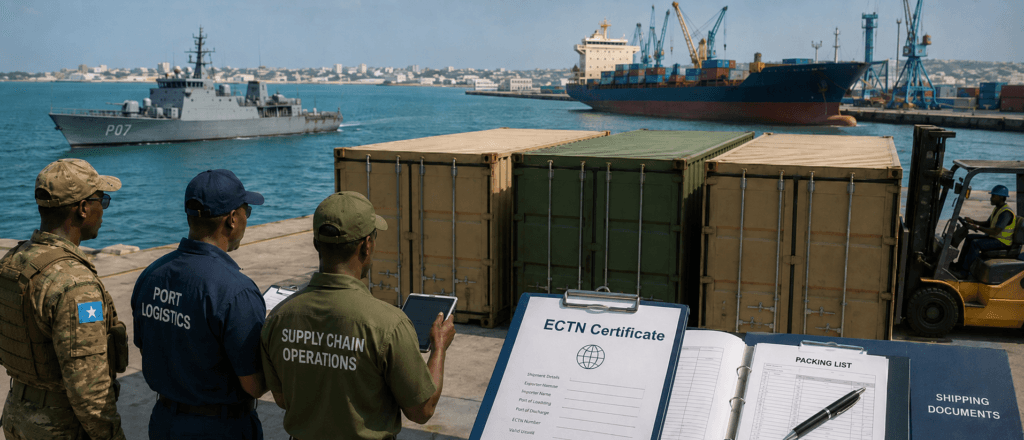
Essential Supply Chain Adaptations for Foreign Military Cargo Entering Mogadishu
Recent directives issued by the Somali port authorities require rigorous ECTN verification for all containers, eliminating long-standing exemptions for foreign defense cargo. This case study walks through the mandatory verification milestones, highlighting how these updated measures alter shipping protocols for international task forces operating in the Horn of Africa.
The maritime landscape surrounding the Horn of Africa remains one of the most strategically vital corridors for global trade. To protect commercial shipping lanes and maintain active patrolling against piracy, numerous international task forces and military troops maintain a steady deployment in Somali waters. Sustaining these operations requires a highly efficient, uninterrupted flow of supplies, ranging from tactical equipment to everyday provisions. Historically, specialized cargo destined for foreign military task forces operating on sovereign soil enjoyed certain regulatory leniencies. However, recent regulatory tightening by the Somali government has fundamentally changed the compliance landscape for defense logistics, making a thorough understanding of local maritime documentation more critical than ever.
The Ministry of Ports and Marine Transport of the Federal Republic of Somalia has systematically updated its customs and cargo tracking protocols to enhance national security and supply chain transparency. Under these reinforced measures, the Somalia Electronic Cargo Tracking Note (ECTN) has become an absolute prerequisite for all ocean freight arriving at national entry points, most notably the Port of Mogadishu. Crucially, previous exemptions that shielded humanitarian aid, United Nations shipments, and foreign military cargo from these tracking notes have been officially dissolved. The Somali government now mandates that every single container entering the country must possess a verified certificate before the carrying vessel arrives. This regulatory shift introduces an unexpected layer of compliance for international defense contractors and logistics coordinators who are accustomed to traditional waivers. Failing to secure a valid tracking note can lead to severe operational gridlock, including heavy customs penalties, prolonged port delays, and a total refusal of cargo discharge, which directly threatens the supply readiness of deployed troops.
In this specific case, an international defense supplier sought to transport a critical shipment of subsistence stores to a foreign task force stationed in Somalia. The cargo consisted of three 20-foot dry containers loaded entirely with alimentation and food products destined for the Port of Mogadishu. Because these provisions were vital for the daily sustenance of troops engaged in regional anti-piracy patrolling, any logistical delay at the port would have immediate operational consequences. Recognizing that their historical exemptions were no longer valid under the updated Somali legal framework, the client engaged expert logistics operators to navigate the mandatory documentation workflow swiftly and accurately.
The operational success of this shipment relied entirely on executing the standardized tracking note procedure with absolute precision. The process initiated smoothly when the client compiled and forwarded the fundamental transport documents, which consisted of the Bill of Lading, the commercial invoice, and the corresponding freight invoice. Upon receiving these files, the logistics operator conducted a rigorous internal audit. This stage is critical because the values, cargo descriptions, and weight metrics must match flawlessly between all three documents to prevent immediate rejection by destination authorities. Once the documentation was verified as accurate and fully matching, the operator officially launched the tracking note draft process, adhering strictly to the mandate of issuing only a single draft per Bill of Lading. The completed draft was then delivered directly to the client for final evaluation. While the standard procedure is built to accommodate revisions - either through client-initiated amendments based on revised paperwork or operator corrections for minor clerical errors - this specific case proceeded without a single hitch. The client reviewed the detailed draft, verified that all information aligned perfectly with the physical shipment, and provided immediate confirmation. With the client’s explicit approval secured, the operator bypassed any need for revisions and instantly submitted the complete file for formal authority control. Because the preparatory paperwork was flawless, the Somali regulatory body completed the authority review without raising any queries or objections. The final validated certificate was officially issued and immediately shared with the client. The entire compliance loop was completed well ahead of the vessel’s arrival, ensuring that the critical food supplies could be discharged at Mogadishu without a single moment of administrative delay.
This case underscores the vital importance of proactive compliance in an era of rapidly evolving maritime policies. As the Somali government continues to standardize its import controls, relying on historical precedents or unverified exemptions can jeopardize high-stakes international missions. Partnering with SCK Representation ensures that even the most sensitive supply chains remain resilient, secure, and fully compliant with local laws.
Get Your Certificate
Apply for your ECTN / BESC certificate now. Fast draft, no hidden fees.