The Financial Impact of Document Quality in International Shipping
An urgent Pakistan-to-Madagascar shipment ran up demurrage and detention fees after an illegible customs declaration caused the BSC application to be rejected.
The Risks of Ignoring Professional Logistics Advice
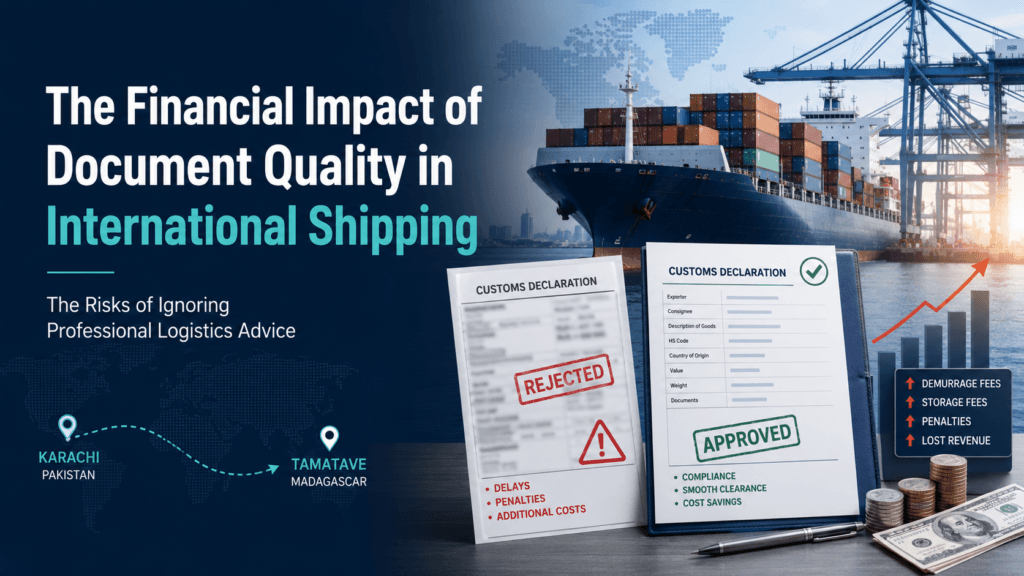
Highlighting the critical nature of compliance, this text outlines an urgent shipment from Pakistan to Madagascar that incurred hefty demurrage and detention fees. Failing to provide legible customs declarations resulted in the rejection of the BSC application, and caused unnecessary and preventable shipping line fees.
When managing international shipping logistics to Madagascar, securing a mandatory Bordereau de Suivi des Cargaisons (BSC) certificate requires strict attention to document quality right from the start. A recent urgent case handled by our team demonstrates how ignoring professional guidance on document compliance can disrupt a supply chain and cost a business significant, preventable penalties. The client approached us with a high-stakes shipment of automotive parts originating from the Port of Karachi, Pakistan, with the final destination set for the Port of Tamatave, Madagascar. By the time they initiated the application, the vessel had already arrived at the port of discharge in Tamatave. In maritime transport, every day a container sits uncleared past its free time, the shipping line charges extra demurrage and detention fees, creating immense financial pressure to complete the certification immediately.
The client provided the required documentation chain, including the Bill of Lading (BL), commercial invoice, freight invoice, packing list, and customs declaration for the automotive components. Upon receiving the files, our operator immediately noticed that the customs declaration was completely illegible and asked the client to provide a clear version. The next day, the client sent a new file, but it was just another smartphone picture that was only half-legible. To keep the process moving, our operator went ahead and completed the draft so the client could check the information, but explicitly requested a clear customs declaration once again. The following day, the client approved the draft info but failed to provide the updated document. Our team explicitly warned the client that the Madagascar authorities would likely refuse the application because of the blurry document. Despite the warning, the client insisted that the application was submitted to the authorities to avoid further delays.
Predictably, the next day, the Madagascar authorities refused the application, officially citing the illegible customs declaration as the sole reason for rejection. Our operator immediately contacted the client again, requesting a proper, readable document to fix the issue. The next day, the client finally used a digital scanner to capture the customs declaration and emailed the high-resolution file. The application was resubmitted to the authorities, and the official CNCA certificate was successfully issued the following day, allowing the automotive parts to finally clear customs at Tamatave.
Get Your Certificate
Apply for your ECTN / BESC certificate now. Fast draft, no hidden fees.