Guinea-Bissau ECTN Certificate — The Complete Guide
How the Guinea-Bissau ECTN certificate works: issuing authority, required documents, application process, timeline and the rules that apply.
This guide covers the ECTN certificate for shipments to Guinea-Bissau — who issues it, which documents it needs, how the application runs and what the validation rules are. For the country procedure page, see Guinea-Bissau ECTN.
Overview
The ECTN — Certificado Eletrônico De Embarque (Electronic Cargo Tracking Note) — is the cargo tracking certificate required for shipments to Guinea-Bissau. It is issued by Guinea Bissau Shippers’ Council (CNC-GB). Requirement status: Mandatory.
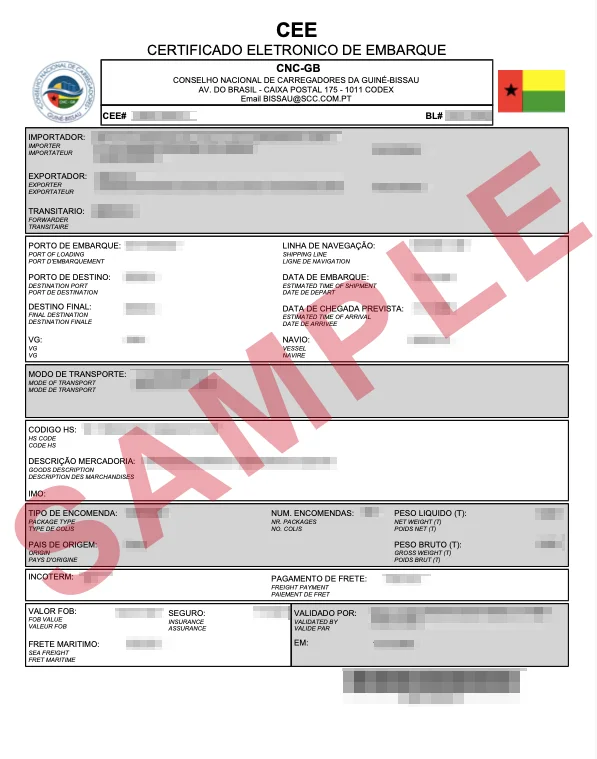
Sample ECTN certificate
A Guinea-Bissau ECTN we filed, with the customer fields masked. Use it to check the layout, where the authority stamp sits and where the reference number is printed.
Required documents
- Bill of Lading
- Commercial Invoice
- Customs Declaration
Application process
1. Send your documents
Share PDF copies of the required documents via sck@scktr.com, or upload them through the application form. There is no need to send hard copies for the issuance of ECTN certificates.
2. Draft is prepared
Once complete, consistent documents arrive, a draft is prepared for your confirmation. A file specialist checks the shipment details against the documents before anything is filed.
3. Confirm the draft
Check every field on the draft — consignee, ports, weights, values and container references. Final documents must be submitted without further amendments; corrections after validation are charged separately.
4. Filing and validation
The confirmed file is submitted to the issuing authority for validation. The ECTN number is issued at validation, so it cannot be shown on documents prepared before that point.
5. Certificate delivered
The validated certificate is sent to you and can accompany the cargo to the destination port.
Timeline
- Processing time: about a week
- Validity: One validated ECTN (CEE) per Bill of Lading.
The exact cut-off depends on the destination and the vessel schedule; confirm the deadline for your shipment with our team before filing.
Special rules
Validation deadline. Following the 08/08/2011 directive, you have 5 days after receiving the ECTN (CEE) reference to forward the original Bill of Lading with place and date of issue and shipped-on-board date, signed and stamped.
Non-compliance. Any change in information or documentation after pre-validation results in a penalty fee. If the original Bill of Lading is not forwarded within 5 days the system automatically cancels the certificate and a penalty fee applies to recover it.
Frequently asked questions
How can you get the ECTN (CEE) certificate?
Share PDF copies of the Bill of Lading (draft accepted, original needed for validation), Commercial Invoice, Freight Invoice (unless freight value is on the Commercial Invoice), and Customs Declaration via sck@scktr.com.
How long does receiving a validated ECTN (CEE) certificate take?
Usually around a week, as Guinea-Bissau’s regulation is strict. Supplied documents must be coherent for the certificate to be validated.
What happens if the certificate cannot be validated within five days of receiving the ECTN (CEE) reference?
You have 5 days to forward the original signed and stamped Bill of Lading. Otherwise the system automatically cancels the certificate and a penalty fee applies to recover it.
Can an export declaration be used for multiple shipments?
Only if all applications and submissions are completed simultaneously. Otherwise the validated copy cannot be issued.
Can I use the same CEE number for various shipments?
No. The CEE is unique and limited to a single shipment; every cargo needs its own verified CEE number.
Ready to file? Apply for a ECTN certificate or go back to the Guinea-Bissau ECTN procedure page. All country guides: Country guides.