 East Africa · Kenya Revenue Authority (KRA) document
 Kenya ACD Certificate
Kenya's ACD - the Advance Cargo Declaration, also called an ECTN - is a mandatory pre-arrival declaration for containerized cargo discharging at Mombasa. The KRA-approved reference code is obtained at the port of loading and endorsed on the Bill of Lading.
Validate before the vessel sails
The Kenya Revenue Authority's ACD platform for containerized cargo has been live since 3 August 2026. The ACD reference code must be obtained at the port of loading and endorsed on the Bill of Lading before the shipment proceeds to a Kenyan port.
No ACD = fines & demurrage
Every shipment unloaded at a Kenyan port must be covered by a validated Advance Cargo Declaration, unless the Bill of Lading shows both a final destination and a consignee outside Kenya. Failure to obtain a valid ACD may lead to fines, delays, cargo rejection, or - in serious cases - seizure. An amendment fee applies for modifications made after validation.
Required Documents - Kenya ACD
Kenya ACD: full requirements
Kenya ACD Certificate
Kenya’s Advance Cargo Declaration has been mandatory for containerized cargo since 3 August 2026. SCK Representation provides the Kenya ACD (ECTN) Certificate - send us your documents and we handle the application from start to finish. The KRA-approved ACD reference is returned within 24 hours of a complete document set.

Obtain Your Kenya ACD Before Shipment
The requirement is in force. Containerized cargo destined for Kenyan ports must be accompanied by a valid Advance Cargo Declaration reference code. Submit your shipment documents to our team for a preliminary review and assistance with the Kenya ACD application process.
Regulations are subject to change. We recommend confirming the latest country-specific requirements with our team via email.
What Is the Kenya ACD?
The Advance Cargo Declaration, commonly abbreviated as ACD, is Kenya’s pre-arrival cargo declaration system. It allows cargo, vessel, exporter, importer, and shipment information to be submitted before the goods arrive at a Kenyan port. The declaration supports advance customs assessment and helps authorities identify and process incoming cargo more efficiently.
The Kenya Revenue Authority’s ACD platform for containerized cargo went live on 3 August 2026 and applies to shipments from that date onward. The ACD reference code must be obtained at the point of loading and endorsed on the Bill of Lading before the shipment proceeds to Kenya.
What Documents Are Required?
To apply for a Kenya ACD, you must submit:
- Bill of Lading
- Commercial Invoice
- Freight Invoice
- Export Declaration
All documents must be clear and readable, and the declaration should include the applicable container details and HS Codes. The information across the documents must be consistent - shipper, consignee, cargo description, quantities, weight, value, freight amount, ports, vessel details, and container information.
To start the certification process, share PDF copies of the documents through sck@scktr.com. There is no need to send hard copies. Please share the final documents, as an amendment fee applies for modifications made after the certificate is validated.
How the Process Works
- Send your documents - email the available shipping documents and shipment information.
- Document review - our team checks the files for missing, inconsistent, or unclear information before submission.
- ACD application - the declaration is prepared using the information supplied by the shipper, exporter, or freight forwarder.
- Reference code issued - once the application is reviewed and accepted by the relevant authority, an ACD reference code is generated.
- Bill of Lading updated - the ACD reference code is endorsed on the Bill of Lading before the shipment proceeds to a Kenyan port.

Why Apply Early?
Late or incomplete declarations may result in document amendments, customs delays, additional operational costs, cargo holds, and loading or clearance complications. You should apply as early as possible and before the vessel departs from the port of loading, allowing enough time for document review, corrections, and validation before the shipment reaches Kenya.
Is the ACD Required for All Shipments to Kenya?
According to the official Kenya ACD platform, every shipment unloaded at a Kenyan port must be covered by a validated Advance Cargo Declaration. Transit cargo is exempt only when the Bill of Lading shows both a final destination and a consignee outside Kenya and clearly identifies the transit movement; if the consignee is in Kenya or Kenya is the final destination, the ACD is required even if the cargo moves on to another country. Confirm shipment-specific requirements before loading, particularly for unusual cargo types, transit arrangements, or non-standard movements.
Government ECTN & ACI Solutions
Kenya’s ACD is one of a wider set of pre-arrival cargo declaration systems. SCK Representation also builds and operates ECTN / ACI platforms as a service for government customers - see Government ECTN Solutions. On Kenya, SCK’s role is to prepare, file and follow your declaration; approval and validation remain with the Kenyan authority.
Official Kenya ACD sources
The Kenya ACD is run by the Kenya Revenue Authority (Commissioner for Customs and Border Control). KRA lists operations@acd.kra.go.ke and info@acd.kra.go.ke for ACD enquiries.
- KRA public notice: ACD Platform for Containerized Cargo (14 July 2026)
- KRA ACD platform: acd.kra.go.ke
Sources checked on 15 October 2026.
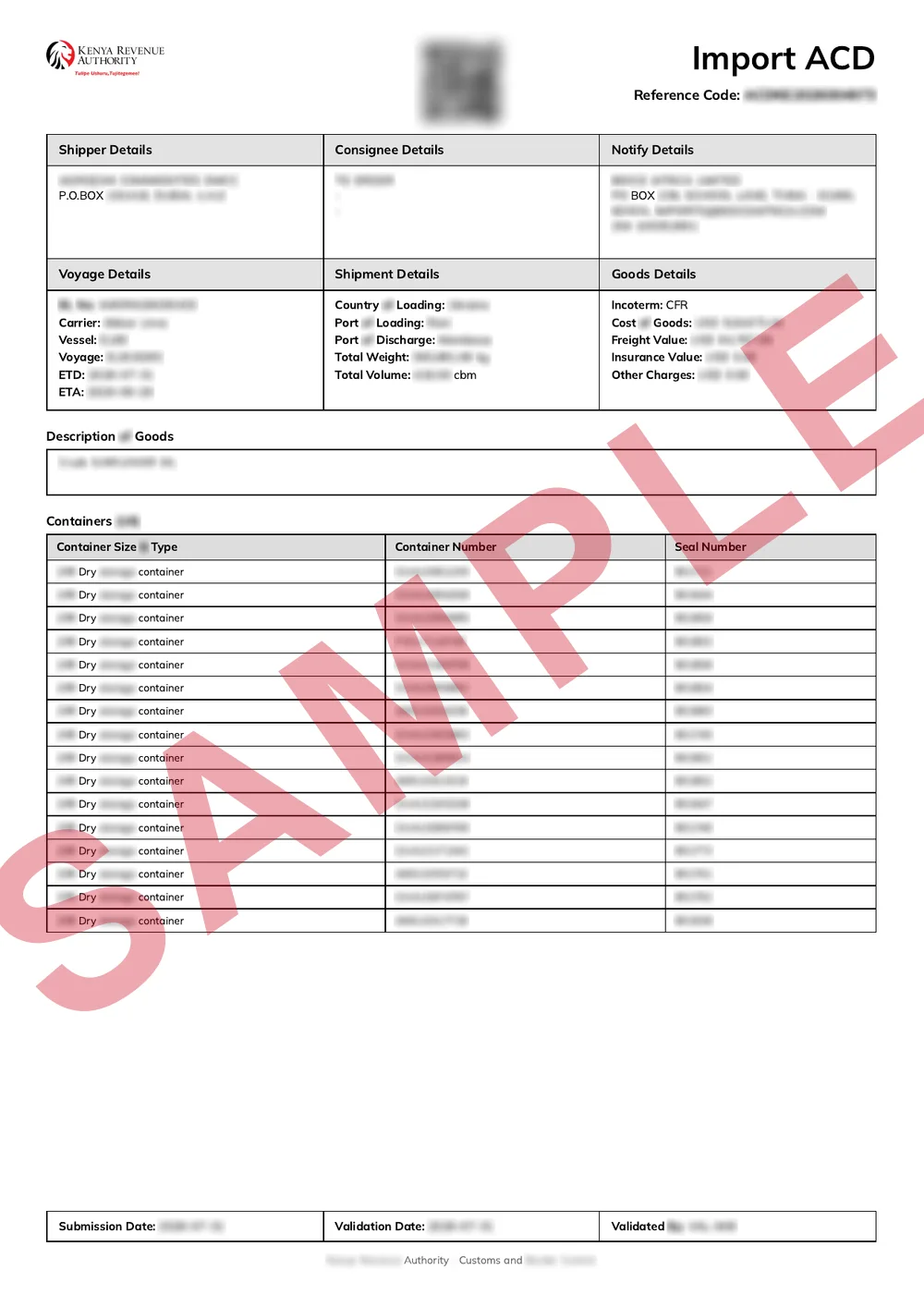
What a validated Kenya ACD looks like
A certificate we filed, with the customer fields masked. Use it to check the layout, where the authority stamp sits and where the reference number is printed.
Kenya ACD: the complete guide
Issuing authority, required documents, application process, timeline and the rules that apply - in one page.
Frequently Asked Questions
Is the Kenya ACD required for transit cargo?
How do I check a Kenya ACD?
Does KRA charge a fee for the ACD?
What does ACD stand for in shipping?
How do I get an ACD for Kenya?
Since when is the Kenya ACD mandatory?
Can you apply using a draft Bill of Lading?
How long does it take to get Kenya ACD approval?
Can one Kenya ACD cover multiple shipments?
Who is responsible for obtaining the Kenya ACD?
When should you apply for the Kenya ACD?
Apply for the Kenya Advance Cargo Declaration as early as possible and before the vessel leaves the port of loading.
The ACD must be obtained at the port of loading and the reference code endorsed on the relevant Bill of Lading.
Applying early leaves enough time for document review, corrections and validation before the shipment reaches Kenya.
Must the Kenya ACD reference number appear on the Bill of Lading?
Yes. The Kenya ACD reference code must be added to every relevant Bill of Lading.
The code is obtained at the port of loading and endorsed on the shipping documents before the vessel sails for Kenya.
Failing to add a valid ACD reference can lead to delays, fines, rejection of the cargo at the port of entry, or other enforcement measures.
Who needs a Kenya ACD?
A Kenya ACD may be required when you are:
- Exporting containerized cargo to Kenya
- Importing goods through a Kenyan port
- Acting as a freight forwarder or shipping agent
- Preparing shipping documents for a customer
- Managing Customs clearance for cargo arriving in Kenya
Applications should be completed before loading or departure to avoid documentation problems at the destination.
What Are the Kenya ACD Fees?
Kenya ACD fees may depend on the shipment details, cargo configuration, number of containers, and other applicable declaration requirements.
A complete quotation can be provided after reviewing the shipment information and supporting documents.
For current fee information, please contact our team at sck@scktr.com.
What Happens If a Shipment Does Not Have a Valid Kenya ACD?
Failure to obtain a valid Advance Cargo Declaration may result in fines, shipment delays, cargo rejection at the port of entry, or other Customs enforcement measures.
In serious cases, cargo may be subject to seizure or confiscation. The declaration should therefore be obtained and validated within the required timeframe before the vessel arrives in Kenya.
Who Issues the Kenya ACD Certificate?
The Kenya ACD is issued by the competent Kenyan authority. SCK Representation provides customers with document review, application preparation, and submission coordination; approval and validation remain subject to that authority.
Latest Kenya updates
Procedure changes and official notices from the issuing authority.
Also shipping to other African ports?
Each destination has its own cargo tracking note. The countries below share this document family or this corridor.








Trusted by exporters and freight forwarders shipping from Türkiye to Africa
A few of the brands that rely on us for the ECTN, BESC and CTN documents their cargo needs.
 DHL
DHL  Maersk
  CMA CGM
  APL
APL  CEVA Logistics
  Bolloré Logistics
  Aramex
  SGS
SGS  Nestlé
  Danone
  TotalEnergies
  Heidelberg Materials
  Arkas Lojistik
  Horoz Lojistik
  Mutlu Makarna
  Nuh'un Ankara Makarnası
  Oba Makarna
  Pakmaya
  Remant Logistics
  OCETRA
  Africa Global Logistics
  Naxco
Naxco  CCIS
CCIS  Gulf First Shipping & Logistics
  Globelink West Star Shipping