Navigating Ghana Customs: Why Accurate SPN Paperwork Matters
Inaccurate cargo descriptions delayed a Ghana SPN certificate and exposed the shipment to demurrage at Tema. The corrections the authority required.
Resolving Critical Documentation Discrepancies for Ghana Cargo Clearance
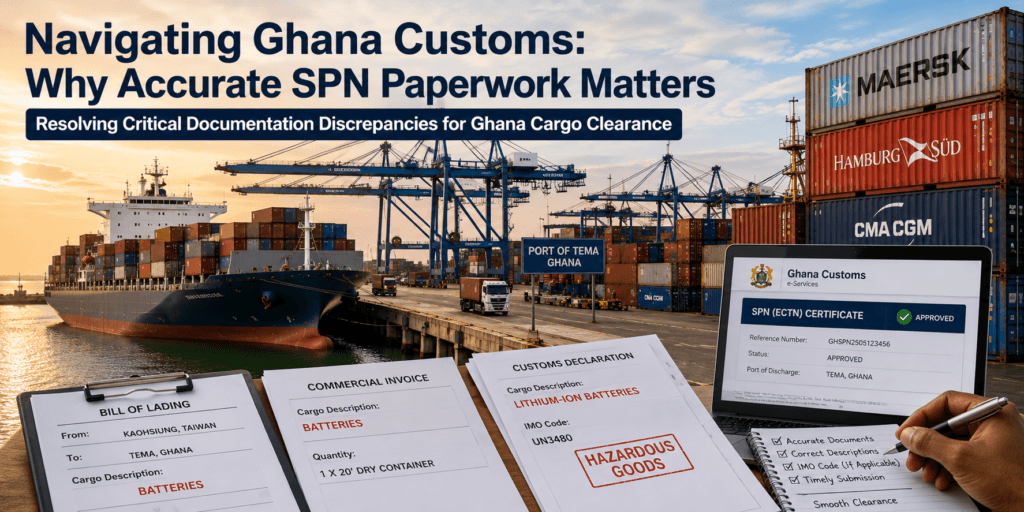
An analysis of a shipment where inaccurate cargo descriptions caused delays in issuing a Ghana SPN certificate. It highlights the workflow required to correct paperwork and the impact of documentation errors on shipping line demurrage. Contacting professional operators can help clarify these compliance steps.
In international logistics, securing the mandatory Ghana SPN certificate, is a critical step for smooth customs clearance. Any discrepancies or delays in this compliance process can lead to severe financial penalties, such as on-ship demurrage fees at the port of discharge. This case study highlights an urgent shipment originating from the port of Kaohsiung, Taiwan bound for the port of Tema, Ghana, involving one 20 feet dry container. The client attempted to accelerate the certificate draft process while intentionally providing incomplete and misleading cargo descriptions to avoid dangerous goods transportation fees, ultimately resulting in costly port delays.
The process began when the client urgently requested a Ghana SPN draft, stating that the vessel carrying their 20 feet dry container was rapidly approaching the port of Tema and they desperately needed to avoid any potential shipping line demurrage. The client provided the Bill of Lading (BL), Commercial Invoice, and Freight Invoice mapping the route from Kaohsiung to Tema, but omitted the required Customs Declaration, promising to send it as soon as it was ready. To assist the client in this high-pressure scenario, the operator initiated the draft process using the available documents, which simply described the cargo under the general term of batteries, as stated as such in the provided documents. A draft was issued for the client’s review while the operator waited for the missing customs declaration to finalize the validation.
Two days later, the client approved the initial draft and finally submitted the official Customs Declaration. During a meticulous compliance check to ensure all values and descriptions matched perfectly across the entire documentation set for this Taiwan to Ghana shipment, the operator noticed a critical discrepancy. The Customs Declaration revealed that the cargo inside the 20 feet dry container was actually lithium-ion batteries, which are strictly classified as hazardous materials requiring a specific International Maritime Organization (IMO) code. The client had knowingly simplified the cargo description on the Bill of Lading and Commercial Invoice to circumvent the extra hazardous cargo fees typically charged by the shipping line for dangerous goods transportation.
Recognizing the severe legal and regulatory risks, the operator immediately advised the client that the Ghana SPN application would face an outright refusal by government authorities unless the shipping documents were corrected. The client spent another day trying to resist adding the proper description and IMO code, still hoping to avoid the extra dangerous goods fees. However, the operator firmly guided them through the compliance requirements, explaining that accurate documentation is non-negotiable for customs clearance at Tema. After an additional two-day delay, the client finally provided the revised, correct documents. The operator swiftly updated the SPN draft with the proper cargo description and IMO code, obtained the client’s final approval, submitted it for authority control, and secured the approved certificate the very next day.
Ultimately, the 20 feet dry container was successfully cleared, but the client was hit with expensive demurrage charges from the shipping line. This financial loss was entirely due to the client’s decision to hide the dangerous goods classification and submit faulty documentation delaying the certificate issuance while the vessel arrived at the port of Tema. This case demonstrates that attempting to bypass maritime safety fees through inaccurate paperwork only leads to heavier penalties. To avoid these costly delays, it is best to partner with experienced document providers to guide you through the process and ensure a smooth shipping experience.
Get Your Certificate
Apply for your ECTN / BESC certificate now. Fast draft, no hidden fees.