Penalized Cameroon Cargo Shipments
Learn about penalized Cameroon BESC cases, late submission penalties, 200% penalty risk, cargo delays, and how to prevent BESC issues before vessel arrival.
Penalized Cameroon Cargo Shipments: What Is the BESC Late Submission Penalty?
For sea shipments to Cameroon, the BESC certificate is one of the most important compliance documents in the import process. BESC, also known as ECTN, is a mandatory cargo tracking document required for goods imported into Cameroon.
The timely preparation and approval of the Cameroon BESC certificate is essential for ensuring that customs procedures at the destination port proceed smoothly. If the document is submitted late, processed with missing documents, or not approved before the vessel’s arrival, the file may become subject to penalties.
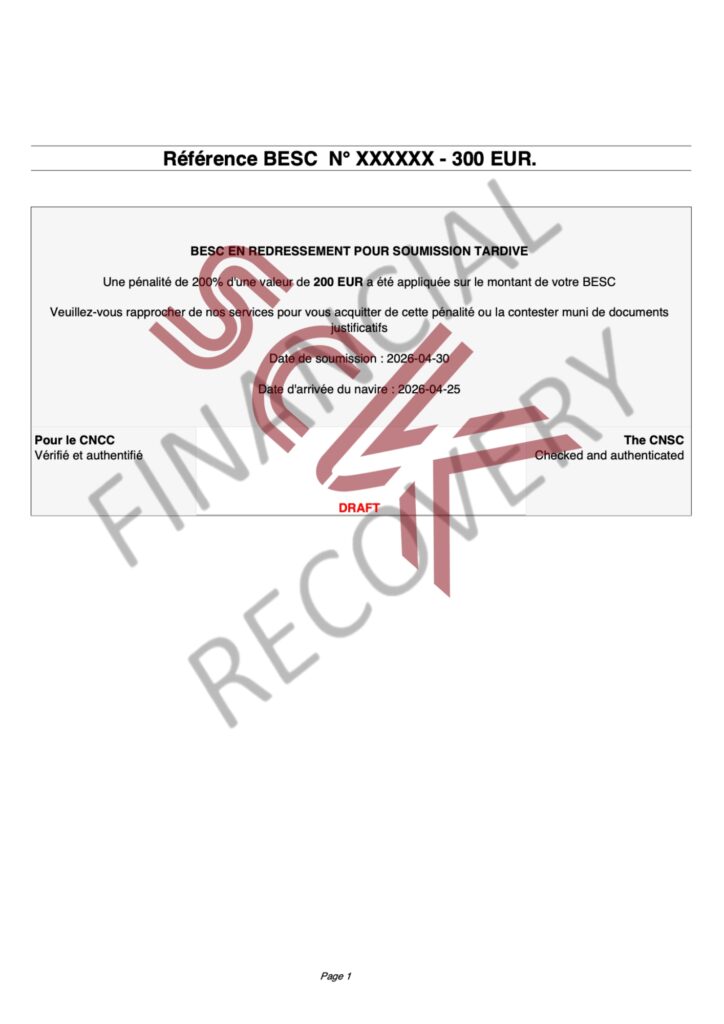
Cameroon Penalty Sample:
What Is the Cameroon BESC Late Submission Penalty?
One of the most critical points in Cameroon BESC procedures is that the certificate must be approved before the vessel arrives. The Cameroon BESC certificate must be approved at least 48 hours before the vessel’s arrival. If this deadline is not met, the cargo may face penalties, delays, or blockage risk at the destination port.
In cases of late submission, the BESC file may be placed under “redressement,” meaning correction or penalized status. In this situation, an additional penalty may be applied to the BESC amount. In a Cameroon BESC file that became penalized due to late submission, the submission date was after the vessel arrival date, and a 200% penalty was applied to the BESC amount. The related penalty amount was stated as 200 EUR.
For this reason, BESC procedures for Cameroon shipments should not be left until the last moment and must be completed before the vessel’s arrival date.
How Does a Penalized BESC Situation Occur?
- A penalized BESC situation for Cameroon cargo usually occurs due to the following reasons:
- The BESC application is submitted after the vessel’s arrival
- Required documents are provided late
- Bill of lading, invoice, or freight details are incomplete
- The process is left until the last moment by the exporter, importer, or freight forwarder
- Changes in the arrival date are not properly monitored
Especially in countries like Cameroon, where BESC procedures are actively monitored, delays in the documentation process directly increase the risk of penalties.
Who Is Affected by a Penalized Cameroon BESC?
A late submission penalty does not only affect the party applying for the certificate. It may affect the entire logistics process. The importer, exporter, freight forwarder, and customs broker may be directly or indirectly impacted by this situation.
- When a BESC file becomes penalized:
- An additional penalty amount may need to be paid
- The certificate approval process may take longer
- Customs clearance may be delayed
- Operational waiting times may occur at the destination port
- Commercial disputes may arise with the consignee
Therefore, BESC should not be considered a document that can simply be “handled at destination.” It should be followed from the beginning of the shipment planning process.
How Can You Prevent Penalty Risk for Cameroon Cargo?
The most important step in preventing penalty risk for shipments to Cameroon is to start the BESC / ECTN process on time according to the loading and arrival schedule. The Cameroon BESC certificate must be approved at least 48 hours before the vessel’s arrival. If this deadline is not met, the cargo may face penalties, delays, or blockage risk at the destination port.
For this reason, required documents such as the bill of lading, commercial invoice, freight invoice, and import declaration should be prepared as early as possible and submitted for review. If the freight amount is not shown on the commercial invoice, a separate freight invoice must be provided. For RoRo vehicle shipments, as of 1 May 2025, additional documents such as FIMEX or a valid special import permit may also be required.
Before submitting the BESC application, the vessel arrival date, bill of lading details, consignee and shipper information, freight details, cargo description, and import declaration must be carefully checked. This is because changes made after approval may be subject to penalties.
In the Cameroon BESC process, responsibility belongs to the shipper. Therefore, checking the BESC requirement before the shipment is completed, preparing all documents correctly, and obtaining certificate approval on time are critical to avoiding possible penalties and operational delays.
For shipments to Cameroon, you may contact SCK Representation to prevent your BESC process from becoming penalized or to evaluate an existing penalized file.
Conclusion
For shipments to Cameroon, the BESC certificate should not be considered a mere formality. It is a mandatory cargo tracking document that directly affects the customs process, cargo release, and operational flow at the destination port.
Late application, missing documents, incorrect information, or failure to obtain certificate approval before the vessel’s arrival may create serious penalty and delay risks. The fact that a 200% penalty may be applied to the BESC amount due to late submission clearly shows how important it is to complete the process on time.
To avoid unnecessary costs, penalties, and operational delays for your Cameroon shipments, BESC procedures should be handled by experienced teams and all required documents should be prepared on time.
Get Your Certificate
Apply for your ECTN / BESC certificate now. Fast draft, no hidden fees.