 Central Africa · Official cargo tracking document
 Equatorial Guinea FESO Certificate
The Equatorial Guinea FESO (Formulario Electrónico para el Seguimiento de Operaciones) is a mandatory loading certificate for every import into Equatorial Guinea. One validated FESO covers one Bill of Lading for cargo discharging at Malabo or Bata.
Validate before the vessel sails
No FESO = fines & demurrage
Freight not covered by a loading certificate will be penalized at the destination port, and failure to present the FESO upon shipment arrival can lead to severe penalties. A penalty fee also applies for modifications made after the certificate has been validated.
Required Documents — Equatorial Guinea FESO
Equatorial Guinea FESO — short explainer
Equatorial Guinea FESO: full requirements
SCK Representation is an authorized FESO, BESC, FESO and cargo tracking note provider for shipments to African countries, filing from Istanbul since 2001.
What the Equatorial Guinea FESO is
The FESO (Formulario Electrónico para el Seguimiento de Operaciones) is the pre-loading declaration Equatorial Guinea’s customs administration uses to see a shipment before it arrives. It records the cargo, its weight and value, the parties and the routing. Equatorial Guinea has required it on all imports since 2000, and it applies to every shipment brought in for commercial, business, diplomatic or personal purposes.
Required documents for the Equatorial Guinea FESO
| Document | What it proves |
|---|---|
| Bill of Lading | The contract of carriage — vessel, ports, containers and the parties. A draft copy opens the file; the original is needed to validate. |
| Commercial Invoice | The declared value and the HS codes customs assess the cargo against. |
| Freight Invoice | The freight amount, required only when the commercial invoice does not state it. |
| Export Customs Declaration | The loading country’s own record of the shipment. Unless the sale is cross-trade, every detail must match the other documents. |
Send PDF copies to sck@scktr.com. Hard copies are not needed. Send final documents: a change made after validation carries an amendment fee.
How the Equatorial Guinea FESO is issued
- Send the documents. A draft Bill of Lading is enough to start.
- Pre-screen. We check value, weight, container and party details against each other before anything is filed. Mismatched documents are the single most common reason a declaration is refused.
- Draft issued. Normally the same working day once the file is complete and consistent.
- Validation. The original Bill of Lading goes with the file for approval, normally within a few days.
- Number onto the Bill of Lading. The validated FESO reference travels with the shipping documents to the discharge port.
When to apply
Before loading. The certificate is obtained at the port of loading, and cargo that arrives at a port in Equatorial Guinea without one is penalised at destination.
How long an Equatorial Guinea FESO is valid
One validated FESO covers one Bill of Lading. It is not reusable: a second shipment, or a split Bill of Lading, needs its own validated number.
Who files the Equatorial Guinea FESO
The shipper or the freight forwarder at origin obtains it from the authorized representative. Responsibility sits with the shipper, and the shipper carries the loss if the cargo travels uncovered.
What happens if cargo arrives without one
Freight not covered by a loading certificate is penalised at the destination port, and failure to present the FESO on arrival can lead to severe penalties. An amendment fee also applies to changes made after the certificate has been validated.
What an Equatorial Guinea FESO costs
Two parts: the tariff set by the issuing authority, which varies with cargo type, container count and tonnage, and our fee for preparing, filing and following the declaration through validation. We quote both as one figure once we have seen the shipment details — email sck@scktr.com.
Which ports it covers
Malabo, on Bioko, and Bata on the mainland, plus cargo discharged there for onward movement.
Other names for this document
FESO is Equatorial Guinea’s name for this declaration. In neighbouring Central African markets it appears as a BESC in Cameroon, a BIETC in Gabon, an ECTN in the Republic of Congo and a FERI in the DR Congo.
Regulations are subject to change, we recommend confirming the latest country-specific requirements with our team via email.
Verified Compliance Review
This content is reviewed to ensure accuracy and consistency with FESO (FESO, BESC, FESO, BIETC, FERI, ACID, ACD) procedures, based on current operational practices and applicable regulatory frameworks at the time of the last update.

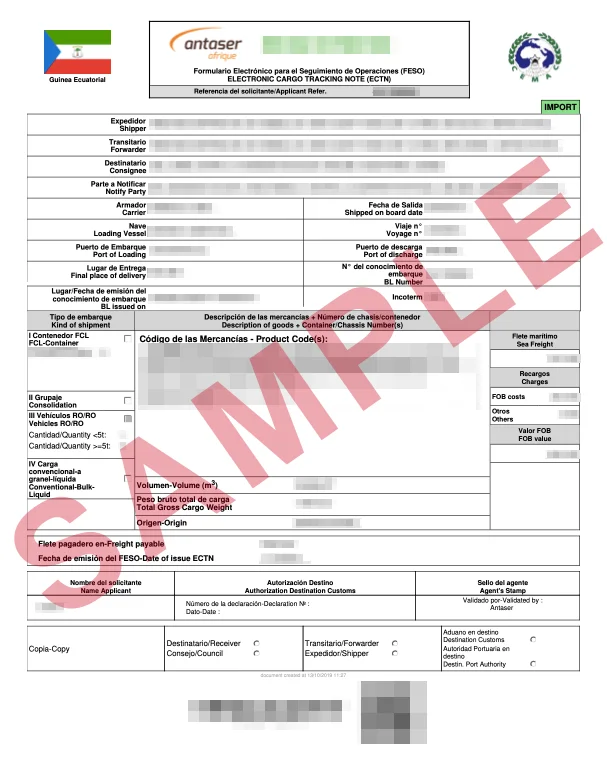
What a validated Equatorial Guinea FESO looks like
A certificate we filed, with the customer fields masked. Use it to check the layout, where the authority stamp sits and where the reference number is printed.
Equatorial Guinea FESO: the complete guide
Issuing authority, required documents, application process, timeline and the rules that apply — in one page.
Frequently Asked Questions
Can I use the same FESO number for various shipments?
How can I get an Equatorial Guinea FESO certificate?
Since when has the FESO been required for Equatorial Guinea?
Which shipments require the FESO?
Also shipping to other African ports?
Each destination has its own cargo tracking note. The countries below share this document family or this corridor.








Trusted by exporters and freight forwarders shipping from Türkiye to Africa
A few of the brands that rely on us for the ECTN, BESC and CTN documents their cargo needs.
 DHL
DHL  Maersk
  CMA CGM
  APL
APL  CEVA Logistics
  Bolloré Logistics
  Aramex
  SGS
SGS  Nestlé
  Danone
  TotalEnergies
  Heidelberg Materials
  Arkas Lojistik
  Horoz Lojistik
  Mutlu Makarna
  Nuh'un Ankara Makarnası
  Oba Makarna
  Pakmaya
  Remant Logistics
  OCETRA
  Africa Global Logistics
  Naxco
Naxco  CCIS
CCIS  Gulf First Shipping & Logistics
  Globelink West Star Shipping