Angola – The Cost of Mismatched BL and DU Files
Angolan customs require the Bill of Lading, invoices and Documento Unico to match exactly. A fertilizer shipment to Luanda shows what one CBM conflict costs.
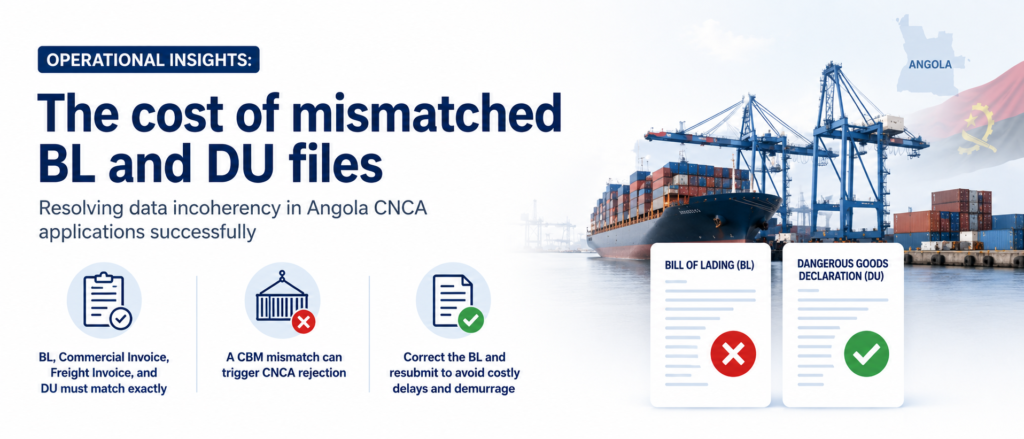
Operational Insights: The Cost of Mismatched BL and DU Files
Resolving data incoherency in Angola ARCCLA applications successfully
Angolan customs authorities enforce a rigid validation process where the Bill of Lading (BL), Commercial Invoice, Freight Invoice, and Documento Único (DU) must match perfectly. This breakdown examines a recent fertilizer container shipment to highlight the mechanics of an ARCCLA rejection. By mapping the cause-and-effect of a volume (CBM) data conflict, we provide a definitive compliance blueprint for global shippers looking for first-time application approval.
Navigating international trade documentation requires absolute precision, particularly when securing an ARCCLA certificate for shipping to Angola. The standard Angola ARCCLA application process is straightforward but rigid. It begins when a client provides essential shipping documents, including the Bill of Lading (BL), Commercial Invoice, Freight Invoice, and the Documento Único (DU). An experienced operator reviews these files to ensure all values, weights, and volumes match perfectly before generating a single draft certificate per BL. Once the client reviews and approves this draft, the operator submits it to the Angolan authority for official control. If the authority finds no issues, the final ARCCLA certificate is issued, clearing the way for a smooth cargo release. However, cutting corners or ignoring documentation mismatches can lead to expensive complications, as highlighted by a recent real-world case.
In this specific instance, a client approached our team in urgent need of an Angola ARCCLA certificate for a shipment of fertilizer transported in two 40-foot dry containers from the Port of Mersin, Turkey, to the Port of Luanda, Angola. Due to severe time constraints, the client submitted the BL, commercial invoice, and freight invoice, but informed us that the DU would be sent shortly. Hoping to expedite the process for this urgent maritime shipment, the client requested that we issue the draft swiftly based on the available information. To accommodate their timeline, our operators began processing the draft immediately. The preliminary draft was completed and sent to the client for verification. Shortly after, the client confirmed the draft details and forwarded the missing DU.
Upon cross-referencing the newly received DU with the existing paperwork for the fertilizer shipment, our operator detected a critical discrepancy: the total CBM (Cubic Meter) volume indicated on the DU did not match the volume stated on the BL. When alerted to this inconsistency, the client assured us that the DU contained the correct volume and requested that we take the DU as the base value for the application. Our team immediately advised against this, explaining that Angolan customs authorities strictly mandate that all documentation must be perfectly matching. To proceed successfully, the BL had to be revised to reflect the correct CBM for the two 40-foot containers.
Fearing the amendment fees associated with altering an Original Bill of Lading (OBL), the client insisted that the BL could not be revised. Our operator clearly instructed the client that the application would face a guaranteed refusal from the authorities with the current mismatched documents. Despite the warning, the client insisted on proceeding with the submission to Luanda. As anticipated, the Angolan authority formally rejected the application due to the data inconsistency.
Faced with the official rejection, the client accepted the outcome and proceeded to contact their carrier in Turkey to revise the BL. Once they provided the corrected BL holding the proper CBM value, our team updated the draft and re-applied. With all documentation finally aligned, the application was accepted, and the final ARCCLA certificate was issued without further delays.
Unfortunately, this back-and-forth cost the client valuable time, resulting in expensive demurrage fees at the port of Luanda. These extra expenses and operational delays could have been entirely avoided if the client had sent all required documents as a single, accurate batch during the initial application and accepted the guidance of the operator regarding the necessary BL revision. In international logistics, compliance and expert guidance are always the fastest and most cost-effective path to success.
Contact SCK Representation for your ARCCLA Certificate.
Get Your Certificate
Apply for your ECTN / BESC certificate now. Fast draft, no hidden fees.