Can You Amend an Issued Central African Republic BESC Certificate?
Post-issuance changes to a Central African Republic BESC are possible, but they carry an amendment fee and require revised supporting documents.
Correcting Cargo Descriptions on Issued Central African Republic ECTNs
While we recommend finalizing all shipping documents before submitting your certificate application, post-issuance changes are still possible. This guide breaks down the mandatory Central African Republic Bordereau Électronique de Suivi des Cargaisons (BESC) requirements, detailing how to prepare your Bills of Lading, commercial invoices, and customs declarations, and how to successfully process post-issuance document corrections.
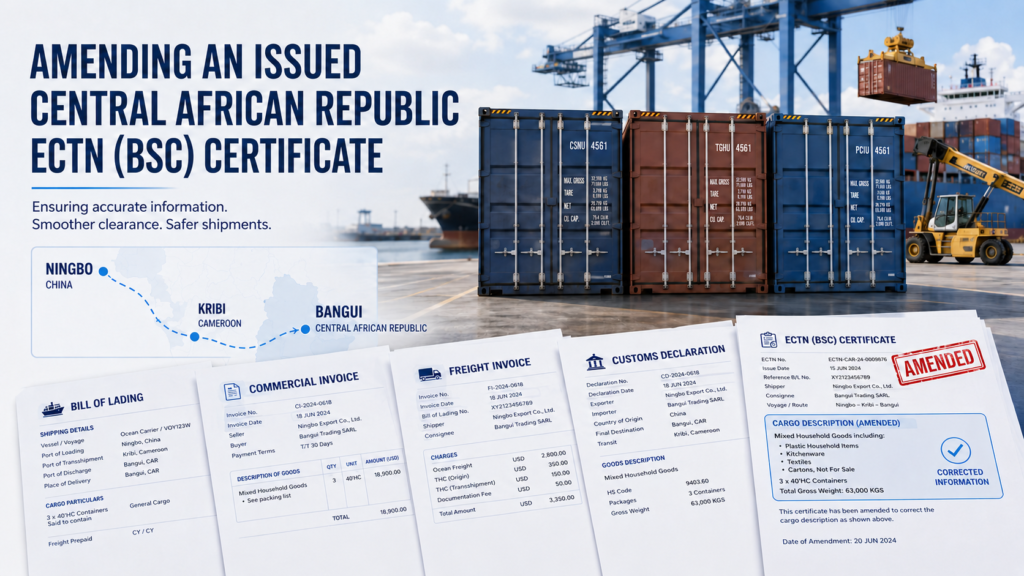
We recently handled the cargo tracking paperwork for a shipment of electrical devices traveling from Ningbo, China, to Bangui in the Central African Republic, using Kribi, Cameroon as the transit port. The shipment filled three 40-foot containers and required a mandatory Central African Republic Electronic Cargo Tracking Note, also called a BESC or BESC certificate. To start the process, the client sent us the required documents: the Bill of Lading, commercial invoice, freight invoice, and customs declaration. Our team reviewed these files to ensure all numbers and information matched perfectly across the paperwork, as the authority only allows one draft per Bill of Lading.
After verifying the information, we created the certificate draft and sent it to the client to check. Normally, clients use this step to fix mistakes or update information based on revised documents. In this case, the details were correct from the start, so the client approved the draft immediately. We then submitted the information to the customs authority for final control. The authority approved it without any issues, and the official, finalized BESC certificate was sent to the client.
A few days after the certificate was fully issued, the client contacted us because they needed to update the description of the goods to add more specific details. Since the certificate was already finalized, changing it required a formal amendment process. We informed the client that we could update the tracking note, but the authority would charge an amendment fee and require revised supporting documents. The client agreed, paid the fee, and sent over the updated paperwork.
Our team applied the updates and submitted the application. The authorities reviewed the amended application, confirmed the new details, and reissued the corrected certificate. This case shows that you can request an amendment on a BESC certificate even after the final version is issued, although it is highly suggested to finalize all documentation before the first BESC application to avoid further delays and amendment fees. To do this successfully, you must provide updated supporting documents that match your new details and pay the customs amendment fee. Working with an experienced team like SCK Representation helps you navigate these changes quickly, keeping your shipment compliant and preventing delays at the destination.
Get Your Certificate
Apply for your ECTN / BESC certificate now. Fast draft, no hidden fees.