From Busan to Lome: The Direct Impact of Mismatched BESC Documentation
How mismatched customs paperwork led to heavy port penalties for a client shipping 18 containers of steel goods from Busan to Lome, Togo.
Togo BESC Compliance Case Study: Avoiding Demurrage and Penalties at Port of Lome
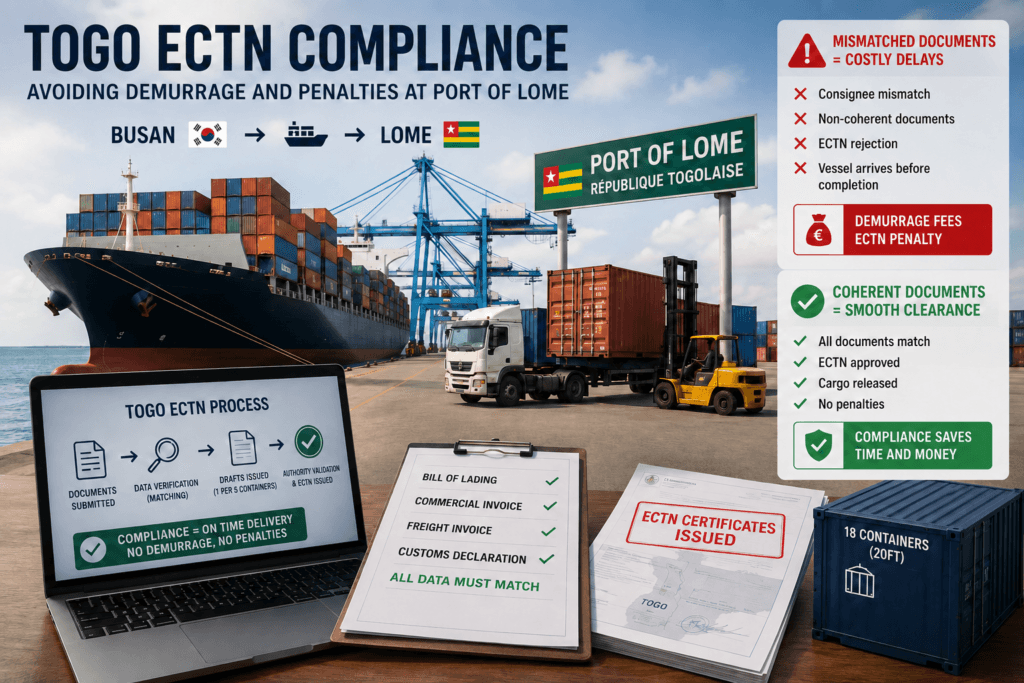
This brief overview explores how mismatched customs paperwork led to heavy port penalties for a client shipping 18 containers to Togo. Featuring an expert step-by-step breakdown of the Togo BESC validation process, this summary highlights the absolute necessity of finalizing mandatory documentation before vessel arrival to prevent costly, avoidable demurrage fees.
Shipping cargo internationally requires strict compliance with maritime regulations, and missing a single detail can lead to costly delays. This was the core challenge faced by a client shipping steel construction goods from the Port of Busan, South Korea, to the Port of Lome, Togo. The shipment consisted of 18 containers of 20-foot capacity. For Togo customs clearance, obtaining a Togo BESC (Bordereau Électronique de Suivi des Cargaisons) certificate is mandatory. Under standard Togo BESC procedures (see the Togo BESC (ECTN) certificate page), one draft is issued per every five containers listed on the Bill of Lading, meaning this specific shipment required four separate drafts to cover the eighteen containers.
The process began urgently when the client submitted the required documents: the Bill of Lading (BL), Commercial Invoice, Freight Invoice, and Customs Declaration. Because the vessel was already nearing the Port of Discharge (POD) in Lome, the client was in a rush to avoid on-ship demurrage and requested immediate processing. Our operators quickly reviewed the files to ensure all values matched perfectly across the paperwork, which is a strict prerequisite for Togo authority approval. With the verification complete, the initial draft process began, and four drafts were successfully issued to the client for final review.
However, an unexpected complication arose mid-process. Due to agreement complications on the client’s side, the consignee information had to be changed entirely. The client provided an amended Bill of Lading reflecting the new consignee. In compliance with strict Togo BESC regulations, our operator informed the client that all documents (meaning the commercial invoice, freight invoice, and customs declaration) must be updated to match the new consignee details. Coherent and identical data across all documentation is mandatory for the BESC process to prevent rejection by government authorities.
Fearing further delays, the client insisted there was no time to amend the customs declaration and pushed to proceed with mismatched documents. Despite our expert guidance warning that authorities would reject non-coherent paperwork, the client left the declaration unchanged. Consequently, the vessel arrived at the Port of Lome while the documentation was still unresolved. The customs declaration was only amended a few days after arrival, triggering both heavy port demurrage fees and an official BESC penalty. The client ultimately had to absorb these avoidable penalties because the documentation was not finalized before the BESC application and because they waited until the last minute to secure the certificate.
Once the client provided the fully coherent, updated documents as originally advised, our team resumed the correction process. The four drafts were revised to perfectly mirror the new consignee information across all paperwork. The client reviewed and confirmed the revised drafts, which were then submitted to the Togo authorities for final validation. The authority completed their control without further issue, and the four final BESC certificates were officially issued and shared with the client.
While the penalties served as a costly lesson in the importance of shipping preparedness, our step-by-step guidance ensured the issue was resolved as quickly as possible, securing cargo release and preventing further losses. Contact SCK Representation for smooth Togo BESC Certification process.
Get Your Certificate
Apply for your ECTN / BESC certificate now. Fast draft, no hidden fees.